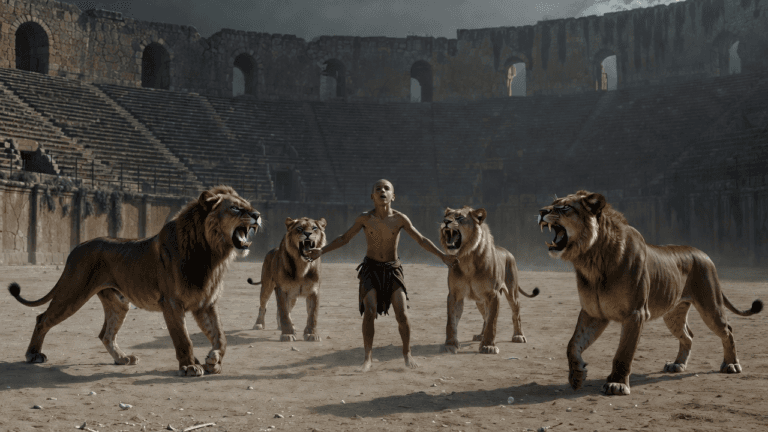

The Corrupt Magistrate Forced the Forgotten Gladiator into an Illegal Private Arena—Not Knowing the Old Man Still Carried a Secret from Rome’s Deadliest Battlefield.
The sand of the Colosseum has a specific scent. It smells of dried copper, sweat, and the heavy, intoxicating perfume the wealthy senators pour from the podiums to mask the stench of mortality. I knew that smell well. For ten years, it had been the only air I breathed. But the sand beneath my worn leather sandals right now did not smell like the great arena. It smelled like damp earth, crushed olive leaves, and the cold, unyielding stone of a private prison.
I had been yanked from the Colosseum for an exclusive, highly illegal private trial. I was no longer standing under the open sky of Rome, surrounded by eighty thousand screaming citizens. Instead, I had been forced into the subterranean courtyard of a sprawling villa, hidden somewhere in the hills beyond the city gates. The walls around me were sheer marble, polished to a sickening shine, rising forty feet into the air to form a square pit. At the top, peering over the ornate iron railings, were the faces of Rome’s untouchable elite.
My arms were heavy. Not just from the chains that the guards had only just removed, but from the decades of holding a shield for an empire that had long since erased my name from its records. I was known in the pits simply as Senex—the old man. My hair was gray, cropped close to the scalp, and my back was mapped with the silver lines of old campaigns in the frozen forests of Germania. I was tired. I was so deeply, profoundly tired.
“Move, dog,” a voice barked behind me. The heavy wooden shaft of a spear caught me in the shoulder blade.
I did not stumble. I simply stepped forward, letting my bare feet sink into the imported yellow sand. I wore nothing but a coarse linen subligaculum around my waist, the fabric rough against my scarred skin. The guards who had brought me down here wore pristine bronze armor, their breastplates gleaming in the midday sun that cut through the open roof of the courtyard. They looked like boys playing at war. I had seen more blood on a single Tuesday on the Rhine frontier than they would see in their entire comfortable lives guarding a magistrate’s wine cellar.
I looked up toward the balcony. Sitting on an ivory chair, draped in a deep crimson himation that cost more than an entire legion’s yearly pay, was Magistrate Gaius Antonius. He was a young man, perhaps thirty, with soft hands and a cruel, practiced smile. His father had been a great man. His father had been a general I once bled for. But Gaius was a creature of politics, a man who built his fortune by falsifying temple records, stealing land from widows, and hosting these illegal, private blood games for his wealthy friends.
“You look older than I remember, gladiator,” Gaius called down, his voice echoing off the marble walls. The men and women around him chuckled, leaning over the railing with cups of spiced wine in their hands. They wore heavy gold rings and intricate fibulae on their shoulders. To them, I was not a man. I was a momentary distraction before the roasted boar was served.
“I am old enough to remember when this family had honor,” I said. My voice was raspy, dry as the sand, but it carried.
The laughter on the balcony stopped. Gaius’s face darkened, his soft jaw clenching. He leaned forward, gripping the marble railing until his knuckles turned white. He hated me. He hated me because I knew the truth about his father’s final will. I was the last living witness to a sealed wax tablet that proved Gaius had stolen his brother’s inheritance. That was why I was here. This was no trial. This was an execution, dressed up as a private spectacle to satisfy the twisted vanity of a corrupt magistrate.
“You were brought here to fight, old man, not to speak,” Gaius spat, waving a hand adorned with stolen signet rings. “The arena master said you were undefeated. He said you have survived twenty matches this year alone. Let us see if your weary bones can entertain my guests before they snap.”
I looked around the courtyard. There were no weapons on the sand. No discarded gladius, no heavy wooden rudis, not even a rusted dagger. I was completely unarmed.
“You forget the rules of the games, Magistrate,” I said, keeping my posture straight, my chin leveled at the balcony. “A condemned man is given steel.”
“You are not in the Colosseum, Senex!” Gaius laughed, a sharp, ugly sound. “You are in my house. And here, I make the laws. You have been brought here for a private trial of courage. If you survive, you may walk out the front gates. If you fall, the Senate will never even know you were missing from your cell.”
He raised his hand, signaling the guards standing by the heavy iron gate at the far end of the courtyard.
I squared my stance. I took a deep breath, letting the warm air fill my lungs, forcing my heart to slow its rhythm. The panic is what kills a man in the arena. The fear drains the blood from your limbs before the enemy even strikes. I closed my eyes for a fraction of a second, centering my mind. I expected heavily armed executioners. I expected Thracian fighters or perhaps a dozen desperate slaves promised freedom for my head.
But as the heavy iron portcullis began to grind upward, the sound that echoed from the dark tunnel was not the clatter of bronze shields or the march of leather boots.
It was a low, rumbling growl that vibrated through the soles of my feet.
I quickly realized my opponent wasn’t human.
The air in the courtyard seemed to grow suddenly colder. The wealthy guests on the balcony gasped, some stepping back from the railing, their wine splashing onto the marble floor. Even Gaius looked a mix of terrified and thrilled.
From the absolute darkness of the holding pen, a massive shadow detached itself. It stepped into the stark sunlight, the heavy iron chain around its neck scraping harshly against the stone.
It was a beast of nightmare proportions. A war hound, but larger than any I had seen in the city. Its coat was the color of dried blood and ash, matted and scarred from years of brutality. Its muscles bunched beneath its skin like coiled ropes, and its jaw was wide enough to crush a man’s skull with a single snap. But it was not a wild, mindless animal. It walked with a terrifying, calculated grace. It was a killer bred for the northern battlefields, a creature trained to break cavalry lines and tear armored men from their saddles.
My breath caught in my throat. My eyes locked onto the thick, studded leather collar tight around the beast’s neck. Beneath the dirt and the fresh scratches, I could see the faded imprint of a bronze eagle—the mark of the Ninth Legion.
“Do you see him, old man?” Gaius shouted, his voice cracking with twisted excitement. “He was brought all the way from the borders of Britannia! A true monster of the frontier! He has not been fed in three days. Let us see how long your veteran pride lasts when your throat is in his jaws!”
The hound let out a roar that shook the dust from the walls. It dug its massive, clawed paws into the sand, kicking up a cloud of yellow grit. It lowered its head, its golden eyes locking onto me with a predatory intensity that would have made a lesser man drop to his knees and weep. It prepared to charge, the muscles in its hind legs tensing, ready to close the distance between us in a heartbeat.
The guests above began to cheer, a sick, rhythmic chanting, demanding my blood to stain the pristine sand.
I did not step back. I did not raise my arms to protect my face. I simply stood there, staring into the golden eyes of the beast. My heart hammered against my ribs, but my mind was suddenly pulled back to a freezing night twenty years ago. I remembered the mud of the frontier. I remembered a dying general handing me a whimpering, blind pup wrapped in a blood-soaked legionary cloak.
The beast lunged forward, snapping the heavy iron chain that bound it to the wall. It exploded across the sand, a terrifying blur of muscle and teeth, closing the gap between us with terrifying speed.
I did not move. I waited until the hound was mere feet away, until I could feel the heat of its breath and smell the copper tang of its hunger.
And then, I reached into the deepest part of my memory, and I whistled.
It was not a normal sound. It was a sharp, two-toned trill, a broken melody that had not been heard since the fall of the Ninth Legion.
The beast froze mid-stride, its massive paws skidding violently in the sand…
CHAPTER 2
The silence that fell over the courtyard was heavier than the iron chains they had just stripped from my wrists.
The massive war hound, a beast bred for slaughter in the frozen forests of Britannia, dug its claws deep into the yellow sand. A cloud of dust washed over my bare feet as the creature fought its own momentum. It had been trained to kill at the drop of a gate. It had been starved, beaten, and driven mad by men like Gaius who saw only a weapon, not a soldier. But the two-toned trill I had whistled—a sound born in the mud of the Rhine frontier—was not a command to attack.
It was the call to halt. The command of the old Ninth Legion.
The beast stood mere inches from me. I could smell the dried blood on its coat, the sour stench of its breath, and the ozone scent of pure adrenaline. Its massive chest heaved, pulling in jagged, ragged breaths. The golden eyes, which only a second ago burned with blind fury, were now wide, confused, and searching.
On the balcony above, the wealthy guests were entirely frozen. The women in their fine stolas had stopped fanning themselves. A jeweled goblet slipped from the fingers of a young senator, shattering on the marble below. The crash echoed like a thunderclap, but neither I nor the hound flinched.
I kept my hands lowered, palms open. I did not break eye contact with the animal. In the arena, you learn that beasts do not respect fear, and they do not respect anger. They respect absolute, unshakable authority.
“Do you know me?” I whispered, my voice barely carrying over the raspy breathing of the hound. “Do you remember the mud, boy? Do you remember the cold?”
The hound took a hesitant half-step forward. Its nose twitched, taking in the scent of my sweat, my blood, and the old leather of my subligaculum. The beast had been a pup when I last saw it—a blind, shivering thing wrapped in the cloak of my dying commander. I had spent two years training it before I was betrayed, stripped of my rank, and thrown into the dark cells of the Colosseum. I did not know if a dog could remember a man after twenty years of arena sand and iron cages.
The hound lowered its massive, scarred head. It let out a sound that was not a growl, but a deep, vibrating whine that rattled in its throat. Slowly, deliberately, the beast closed the final inch between us and pressed its wet, heavy snout into the palm of my scarred hand.
I closed my fingers gently around the thick leather collar. Beneath my thumb, I traced the cold bronze of the eagle crest. The Ninth Legion. My legion.
“Good soldier,” I murmured, feeling a sudden tightness in my chest that had nothing to do with the exertion of the games. “Stand with me.”
The hound immediately turned, putting its massive shoulder against my leg, facing the heavy iron gates and the stunned guards. The monster of the frontier was gone. In its place stood a war hound of Rome, defending its commander.
“What is this?” Gaius Antonius shrieked from the balcony. His voice was shrill, completely devoid of the mocking confidence he had held moments before. He leaned so far over the marble railing I thought he might tumble into the sand. “What is happening? The beast is starving! Kill him! Tear his throat out!”
The hound’s ears pinned back. It let out a low, guttural snarl aimed directly upward at Gaius. The magistrate flinched, stepping quickly away from the railing.
“He does not take orders from thieves,” I called out, my voice steady and resonant in the enclosed courtyard. “This hound was bred for the front lines, Magistrate. He knows the difference between a true Roman soldier and a coward wearing stolen silk.”
The guests gasped, muttering to each other in hurried, scandalized whispers. A gladiator did not speak to a patrician this way. An old, nameless man from the pits did not lecture a magistrate in his own home. But I was not just Senex the gladiator anymore. With the weight of the hound leaning against my leg, the ghosts of the Ninth Legion were standing right beside me.
Gaius’s face flushed a deep, ugly purple. He slammed his fist against the marble. “Guards! Kill the dog! Kill the old man! Pin them both to the sand!”
The six guards standing by the gate shifted uncomfortably. They were dressed in polished lorica segmentata and crested helmets, gripping long spears. But they were city guards, men who spent their days breaking up tavern brawls and guarding grain shipments. They looked at me, an undefeated veteran of the Colosseum pits, and then they looked at the blood-stained war hound baring teeth the size of iron spikes.
Nobody moved.
“Did you not hear me?” Gaius roared, his voice cracking. “I pay your wages! I bought your armor! Advance and kill them, or I will have every one of you crucified on the Appian Way by sunset!”
The guards nervously lowered the tips of their spears, forming a jagged, hesitant line. They began to shuffle forward, their leather caligae boots scraping against the sand. The hound felt the shift in tension. It stepped entirely in front of me, planting its paws wide, letting out a roar that shook the very foundation of the villa. Two of the guards flinched, pulling their spears back.
“Hold your ground,” a new voice commanded.
It was a deep, gravelly voice, accustomed to issuing orders over the din of clashing steel. From the dark archway of the subterranean holding cells, a single man stepped out into the light.
He was the Captain of Gaius’s private guard. Unlike the boys holding the spears, this man wore scarred bronze. His crimson cloak was faded, his armor dented from actual use. He did not carry a spear; he held a broad Roman spatha, the sword already drawn and resting easily in his right hand. He walked with a slight limp—a familiar hitch in the hip that spoke of a barbarian axe blow survived long ago.
Gaius pointed a trembling finger at the Captain. “Valerius! Finally! Gut that arrogant old fool and butcher the beast. Do it now, and I will double your silver for the year.”
The Captain, Valerius, did not look up at the balcony. He kept his eyes locked on me and the hound. He stepped through the line of hesitant guards, waving them back with a flick of his wrist. He was a professional. He knew that the boys with the spears would only get in his way.
“You have a strange way with animals, gladiator,” Valerius said, his voice low and dangerous. He stopped ten paces from me, assessing my stance, my lack of weapons, and the protective fury of the hound.
“I have a way with soldiers,” I corrected quietly. “And this hound is a better soldier than the man paying your wages.”
Valerius’s eyes narrowed. He raised his sword, the polished steel catching the midday sun. “It does not matter. The Magistrate has ordered your death. You are unarmed, old man. Tell the beast to step aside, and I will make your end quick. It is the only mercy I can offer.”
I looked at Valerius. I looked past the drawn sword, past the dented armor, and focused on his left forearm, which was exposed beneath his tunic. There, burned into the skin, was a faded, jagged scar. It was a brand. A very specific punishment mark given to soldiers who fell asleep on watch in the northern camps.
My heart hammered a slow, deliberate rhythm. The pieces of the past were aligning in the dust of this illegal arena.
“A quick death,” I repeated softly. “Is that what you offered the men of the Third Cohort when the snow broke their lines, Valerius?”
The Captain froze. The tip of his sword dropped two inches. His eyes widened, staring at me as if a ghost had just crawled out of the sand.
“How…” Valerius breathed, the color draining from his weathered face. “How do you know that name? How do you know about the Third Cohort?”
I stood a little taller, letting the exhaustion drop from my shoulders. “Because I was the one who branded your arm to save you from execution, Valerius. You were a boy of sixteen, shivering in the mud, terrified of the dark.”
The heavy silence returned to the courtyard. On the balcony, Gaius looked frantically between us, sensing the shift in power but unable to comprehend it. The war hound let out a soft whine, leaning heavier against my leg.
“I am not just Senex,” I said, my voice echoing off the high marble walls, carrying up to the terrified elite and piercing the heart of the mercenary captain. “I am General Tiberius, Commander of the Ninth. And you, Valerius, are standing between me and the man who forged my final orders.”
CHAPTER 3
The name hung in the stifling air of the courtyard, heavier than the marble columns that supported the Magistrate’s balcony. General Tiberius. To the wealthy socialites dripping in gold and silk above, it was a name pulled from dusty military archives, a ghost story of a commander who had supposedly died in disgrace. But to the men in the sand, the men who actually held the steel, it was a name that carried the weight of an entire legion.
Valerius stared at me, the tip of his spatha now resting fully in the yellow sand. The fierce, professional composure that had made him the Captain of Gaius’s private guard was fracturing. I watched his eyes track over my face, looking past the gray hair, the deep wrinkles of exhaustion, and the grime of the gladiator pits. He was searching for the commander he had once known, the man who had pulled him from the freezing mud of the Rhine and burned a mark into his flesh so the military tribunals would spare him from the executioner’s block.
His chest hitched beneath his dented bronze armor. His left hand instinctively moved to cover his forearm, tracing the outline of the brand beneath his linen tunic.
“Tiberius…” Valerius breathed, his voice barely a rasp. “They told the cohorts you were executed for treason. They said you stole from the Emperor’s pay wagons. We saw the sealed records with our own eyes.”
“You saw what the Senate wanted you to see, Valerius,” I replied, my voice steady, unhurried. I did not raise my voice, but the acoustics of the death pit carried every syllable upward to the balcony. “I found the rot in the grain lines. I found the men who were starving the northern borders to line their own pockets in Rome. Men like the father of our current host. When I threatened to take the ledgers to the Emperor, I was quietly arrested in the night, stripped of my seal, and thrown into the dark. I have spent ten years bleeding on the sand of the Colosseum under a false name, waiting for the truth to rot away.”
The war hound at my side let out a low, rumbling growl, a steady vibration against my leg. It kept its golden eyes locked on the nervous guards who still held their spears. The beast was a living relic of the truth, a creature that refused to forget the man it was trained to follow.
“Lies!” Gaius Antonius shrieked from above. The Magistrate was gripping the marble railing with such force I thought his manicured fingers might snap. The arrogant sneer had been completely wiped from his face, replaced by the frantic, sweat-slicked panic of a cornered rat. “Do not listen to him, Captain! He is a madman! A broken, concussed gladiator spinning fantasies to save his miserable life! I order you to kill him! If you do not strike him down this instant, I will have you stripped, flogged, and thrown to the beasts yourself!”
Valerius did not move. He stood completely still, caught between the brutal reality of his current employment and the overwhelming weight of military honor. The six young guards behind him shifted nervously, looking to their Captain. They were boys playing at war, and the sudden realization that they were standing in the arena with a legendary general of the Ninth Legion had drained the blood from their faces.
“Captain,” one of the young guards whispered, his spear trembling so violently the wooden shaft rattled against his breastplate. “What do we do?”
I did not let Valerius spiral into indecision. I spoke to him not as a prisoner, but as his commander.
“Look at the beast, Valerius,” I commanded softly.
Valerius shifted his gaze from my scarred face to the massive, blood-stained hound.
“A Roman magistrate can forge a wax tablet,” I said, my voice echoing with absolute clarity. “A corrupt senator can alter a legion’s record. A wealthy man can buy the silence of an entire court. But you cannot bribe the loyalty of a frontier hound. You cannot forge the memory of an animal bred for war. This hound knows my voice, Valerius. Because I am the man who raised it.”
The hound let out a sharp, affirmative bark, tossing its massive head.
The guests on the balcony were beginning to panic. This was supposed to be a secret, illegal execution, a twisted afternoon of entertainment over cups of spiced wine. They had come to watch a nameless old man be torn apart by a monster. They had not come to bear witness to a resurrected general exposing a massive conspiracy of theft and forged wills. Several of the wealthy patricians were already backing away from the railing, their heavy silk cloaks sweeping across the marble floor as they signaled their slaves to prepare their litters for an immediate departure.
“Where are you going?” Gaius screamed, turning his frantic gaze on his departing friends. “No one leaves! The gates are locked! I am the Magistrate here!”
He turned back to the courtyard, his face contorted in absolute rage. He reached under the folds of his crimson himation and pulled out a small, heavy object. It was a gilded crossbow, a cowardly weapon usually reserved for hunting from the safety of a high chariot. He loaded a short, iron-tipped bolt into the groove with trembling hands.
“If the hired swords are too cowardly to do their jobs, I will end this myself,” Gaius spat, aiming the weapon down into the pit. “You should have died in the cells, old man.”
Before Gaius could pull the trigger, Valerius moved.
The Captain did not attack me. He did not issue an order to his men. In one fluid, practiced motion, Valerius drove the blade of his sword deep into the yellow sand, leaving the weapon standing upright, a cross of bronze and steel shining in the sun.
Then, Valerius stepped back, brought his right fist sharply across his chest, and slammed it over his heart.
The sound of the legionary salute cracked like a whip in the silent courtyard.
“Third Cohort, Ninth Legion, Commander,” Valerius shouted, his gravelly voice filled with a fierce, uncompromising pride that had been buried under years of mercenary work. “Awaiting orders.”
The six young city guards, seeing their hardened Captain surrender to the old gladiator, immediately dropped their spears. The heavy wooden shafts clattered uselessly onto the sand. One by one, the boys stumbled backward, terrified of Gaius’s wrath but far more terrified of the legendary general and the war beast standing before them.
“Traitor!” Gaius screamed from the balcony. His hands shook so violently the crossbow wavered off target. “I will see you crucified, Valerius! I will see your name stricken from every registry in Rome!”
“My name was already saved by this man twenty years ago,” Valerius called up to the balcony, not breaking his salute. “You pay me to guard your doors, Gaius Antonius. You do not pay me to assassinate a Roman General to cover up your family’s thievery.”
Valerius turned his eyes back to me. “What are your orders, General?”
I stepped forward, leaving the shadow of the holding cell and walking fully into the warm, natural sunlight of the courtyard. The war hound moved perfectly at my side, its shoulder brushing against my thigh. I felt a surge of strength return to my weary bones. For ten years, I had fought for nothing but my next breath in the dirt. Today, I was fighting for my name.
“The Magistrate holds a sealed wax tablet in his personal archive,” I said, my voice carrying the steady cadence of a battlefield briefing. “It is the true will of his father. A will that names his younger brother as the rightful heir to the estate, and contains the ledger of the grain he stole from the northern legions. He kept it because a corrupt man can never bear to destroy his leverage. He brought me here today because I am the only surviving witness to that seal.”
Gaius’s face turned the color of old ash. The crossbow dropped an inch. The remaining guests on the balcony gasped, the reality of the scandal finally setting in. This was not just an illegal game; this was the unmasking of a stolen fortune.
“Secure the archive, Captain,” I ordered Valerius. “Do not let the Magistrate or his scribes burn a single piece of parchment. Seal the doors to the villa.”
“It will be done,” Valerius said. He finally dropped his salute, pulled his sword from the sand, and turned to the young guards. “You heard the General. Secure the western wing! Move!”
The boys scrambled, eager to be on the winning side of whatever political explosion was about to detonate.
But Gaius was not finished. A man who has built his entire life on stolen wealth and false pride is most dangerous when the facade begins to crack.
“You think you have won because you convinced a washed-up mercenary to salute you?” Gaius laughed, a high, hysterical sound. He raised the crossbow again, aiming it directly at my chest. “You are still in a pit, Tiberius! The gates are barred from the outside! You are an unarmed old man in a linen rag, and I have the high ground. I will put this bolt through your heart, butcher the dog, and tell the Senate you died attempting a slave revolt!”
His finger tightened on the trigger.
I did not flinch. I did not break my stance. I simply placed my hand on the massive head of the war hound.
Before Gaius could release the iron bolt, a heavy, rhythmic thud echoed through the stone of the villa. It was a sound that made every Roman citizen’s blood run cold.
THUD. THUD. THUD.
It was the unmistakable sound of heavy iron caligae boots marching in perfect, terrifying unison on the marble floors outside the courtyard.
Gaius froze, the crossbow shaking in his hands. He looked toward the heavy oak doors that led from the balcony to the main atrium of his sprawling estate. The wealthy guests pressed themselves against the walls, their faces pale with sudden, overwhelming dread.
“Open the gates in the name of the Emperor!” a voice boomed from the other side of the oak doors. The voice was like crushing stone, devoid of emotion, operating entirely on the absolute authority of Rome.
Gaius stumbled backward, the crossbow clattering to the marble floor. “No… no, the audit wasn’t scheduled until next month. The bribes were paid. The records were hidden…”
The heavy oak doors did not open smoothly. They were violently kicked inward, the wood splintering off the hinges.
Through the dust and the broken wood stepped a man wearing the polished silver breastplate of a Praetorian Tribune. Behind him, a dozen elite guards poured onto the balcony, their shields raised, their swords drawn, their purple cloaks sweeping over the shattered glass of Gaius’s spilled wine.
The Tribune did not look at the screaming guests. He did not look at the terrified Magistrate. He walked to the edge of the marble railing, gripped the stone with leather-gloved hands, and looked down into the courtyard.
His eyes scanned the yellow sand. They passed over the discarded spears. They passed over Valerius, who had immediately dropped to one knee out of respect for the Imperial Guard. Finally, the Tribune’s eyes locked onto me, standing in the dirt with the war hound at my side.
The Tribune reached into his belt and pulled out a heavy, dark red wax seal, bearing the crest of the Emperor himself.
“We received a message that a ghost was fighting in the Magistrate’s private arena,” the Tribune called down, his voice echoing in the absolute silence of the courtyard. He held the imperial seal out over the railing. “The Senate requires the true ledger of the Ninth Legion. Tell me, old man. Are you ready to testify?”
CHAPTER 4
The Tribune’s voice did not echo; it commanded. It was a voice forged in the rigid discipline of the Praetorian Guard, carrying the absolute, unquestionable weight of the Roman Emperor. He stood on the ruined balcony, his silver breastplate catching the afternoon sun, the heavy red wax of the imperial seal held out for all to see.
In the pit below, I felt a strange, profound stillness settle over my spirit. For ten years, I had survived in the shadows, fighting nameless battles in the blood-soaked sand of the Colosseum. I had accepted my fate as a forgotten ghost of the Empire. But as I looked up at the Tribune, I knew the long, dark night of my exile was finally over.
Gaius Antonius did not have the dignity to face his ruin like a Roman. The Magistrate dropped his gilded crossbow. It hit the marble floor with a hollow, useless clatter. His knees buckled, and he collapsed into the puddle of spilled wine, the expensive crimson silk of his himation soaking up the dark stain. He looked like a frightened, spoiled child who had suddenly realized that his family name could no longer protect him.
“Tribune… Tribune, listen to me,” Gaius stammered, his voice thin and reedy, devoid of any authority. He raised his trembling hands, the stolen signet rings flashing uselessly in the light. “There has been a mistake. A terrible misunderstanding. This is a private estate. I am a Magistrate of the city. You cannot simply break down my doors. I was executing a dangerous criminal… a rogue gladiator who threatened the peace!”
The Tribune did not even blink. He lowered the imperial seal and smoothly descended the wide marble staircase that led down into the courtyard arena. Behind him, eight Praetorian guards followed in perfect, silent unison. Their heavy leather caligae boots struck the stone steps with a rhythmic finality. They did not shout. They did not draw their weapons wildly. They simply moved into the courtyard and formed a disciplined half-circle, cutting off the iron gates and securing the perimeter.
The wealthy guests on the balcony were utterly paralyzed. The patrician men and women, who only moments before had been laughing and calling for my blood, now shrank back against the walls. They covered their faces with their fine linen cloaks, terrified that the Tribune might recognize them and associate their names with this illegal gathering.
The Tribune stepped off the final marble stair and onto the yellow sand. He ignored the cowering Magistrate above. He ignored the nervous city guards who had dropped their spears. He walked straight toward me.
At my side, the war hound stiffened. The beast let out a low, warning rumble, planting its massive paws firmly in the dirt, placing itself between me and the approaching Praetorian.
I rested my hand gently on the hound’s scarred neck. “Steady, soldier,” I murmured.
The hound’s ears flicked, recognizing my tone. It stopped growling, though its golden eyes never left the Tribune, remaining perfectly alert, perfectly loyal.
The Tribune halted three paces away. He was a younger man, perhaps in his late thirties, with a sharp, intelligent face and the hardened eyes of a veteran. He looked at the hound, then slowly shifted his gaze to me. He took in my gray hair, the deep scars mapping my chest, the rough linen rag tied around my waist, and the sheer exhaustion written in the lines of my face.
For a long moment, the only sound in the courtyard was the ragged breathing of the Magistrate weeping on the balcony.
Then, the Tribune reached up and unclasped his plumed silver helmet. He tucked it under his left arm, exposing his face to the sun in a gesture of profound, deliberate respect.
“General Tiberius,” the Tribune said. His voice was no longer a booming command; it was quiet, steady, and filled with an awe he could not entirely hide. “The Emperor sends his regards. He also sends his apologies. We have searched for you for five years.”
I let out a slow, heavy breath. The tension that had held my spine rigid for a decade finally began to crack. “Five years,” I repeated softly. “And yet, I have been bleeding in the Emperor’s own arena every week. I was not hard to find.”
“You were erased, General,” the Tribune explained, his jaw tightening with controlled anger. “When you threatened to expose the grain theft, the late Magistrate Antonius—Gaius’s father—used half his stolen fortune to bribe the Senate archivists. Your name was physically scraped from the legion registers. Your transfer orders to the prison were sealed under a false identity. Officially, Commander Tiberius of the Ninth Legion died of a fever in Gaul. It was only three months ago, when a retired quartermaster confessed on his deathbed, that the Emperor realized the greatest commander of the northern frontier might still be alive in the pits.”
“Then why wait?” I asked, my voice dry. “Why let me be dragged here today?”
“Because we needed the proof,” the Tribune said, gesturing upward to the balcony. “The Antonius family is powerful. They have senators in their pockets and judges on their payroll. To arrest a sitting Magistrate, the Emperor needed the original ledgers. The proof of the stolen grain, and the proof of the forged will that gave Gaius his unearned power. We knew Gaius kept his father’s true records hidden in this villa, but we could never obtain a warrant to search it.”
The Tribune allowed a grim, tight smile to touch the corners of his mouth. “Until we received a quiet message from a city guard captain this morning. A man named Valerius, who informed us that a highly illegal, unregistered private blood game was taking place here today, providing the Emperor with all the legal justification he needed to breach the gates.”
I turned my head. From the dark archway of the subterranean holding cells, Captain Valerius stepped back into the sunlight. He was not alone. Two of his young city guards walked behind him, struggling under the weight of a heavy, iron-bound cedar chest.
Valerius limped across the sand, his battered bronze armor shining. He stopped before the Tribune, offering a sharp, respectful nod, before looking at me.
“I swore an oath to the Ninth Legion, General,” Valerius said, his gravelly voice thick with emotion. “I may have spent ten years guarding a thief’s door to afford bread, but I never forgot the man who saved my life in the snow. When Gaius ordered you brought up from the Colosseum today… I knew it was time to make things right.”
Valerius signaled his men. The young guards dropped the heavy cedar chest into the sand with a dull thud. Valerius drew his spatha and brought the heavy iron pommel down on the brass lock. The metal shattered. He kicked the lid open.
Inside, stacked neatly upon purple velvet, were dozens of rolled parchment scrolls, thick leather-bound ledgers, and right at the top—a single, pristine wooden wax tablet, bound in leather cord and stamped with the unbroken, authentic seal of the late Magistrate.
The Tribune stepped forward, reached into the chest, and lifted the heavy grain ledgers. He flipped open the thick leather cover, his eyes scanning the columns of numbers, the dates, and the undeniable signatures that detailed the systemic starvation of the frontier legions.
“There it is,” the Tribune said, his voice cold as ice. “Ten years of stolen legionary pay. Ten years of missing grain. Thousands of good men who froze or starved on the border while this family built marble villas and hosted private executions.”
“It’s a forgery!” Gaius shrieked from the balcony, scrambling to his feet, slipping in the wine. He gripped the marble railing, his eyes wild with absolute desperation. “The gladiator planted it! My Captain is a traitor! They conspired against me! You have no right to take those!”
The Tribune closed the ledger with a sharp, echoing snap. He looked up at the balcony, his eyes narrowing with a terrifying, absolute authority.
“Gaius Antonius,” the Tribune declared, his voice carrying to every corner of the estate. “By the authority of the Emperor, and the undeniable evidence of these sealed records, you are stripped of your title, your lands, and your family name. You are hereby charged with high treason, the theft of imperial military supplies, and the illegal imprisonment of a Roman General.”
Gaius opened his mouth to scream a protest, but the words died in his throat. Two Praetorian guards, who had quietly ascended the stairs during the Tribune’s speech, stepped onto the balcony. They did not ask him to surrender. They grabbed Gaius by the shoulders of his fine silk robe, forcing him roughly to his knees. The Magistrate began to sob, a pathetic, broken sound that echoed loudly in the quiet courtyard.
“And as for your guests,” the Tribune continued, sweeping his gaze over the terrified patricians pressing themselves against the walls. “Every man and woman present at this illegal blood sport will be detained, their properties audited, and their names read before the Senate. Guard, secure the prisoners.”
The courtyard erupted into controlled, efficient action. The Praetorians moved with terrifying precision, binding the wrists of the wealthy elite with rough hemp rope, ignoring their protests, their tears, and their desperate attempts to offer bribes. The socialites who had cheered for my death were now being marched down the marble stairs like common thieves, their heavy gold jewelry clinking against the stone.
Down in the sand, the Tribune turned his attention back to me. He signaled to one of his men. A guard stepped forward, carrying a bundle of deep, rich fabric.
The Tribune took the bundle and shook it out. It was a heavy woolen cloak, dyed the deep, unmistakable crimson of a Roman commanding officer, fastened with a heavy bronze fibula shaped like an eagle.
“The Emperor has ordered your name restored to the public record, General Tiberius,” the Tribune said quietly, offering the cloak. “Your back pay for the last ten years has been deposited in the central treasury. Your rank is yours again, should you wish to take command of a legion.”
I looked at the crimson cloak. I thought of the mud of the frontier, the screaming crowds of the Colosseum, and the heavy, rusted iron chains that had dug into my wrists for three thousand days. I thought of the men I had lost, and the men, like Valerius, who had survived.
Slowly, I reached out my scarred, calloused hands. I did not take the cloak to wear it. I gently folded the heavy wool over my forearm, feeling the weight of the bronze eagle beneath my thumb.
“Tell the Emperor I am grateful for his justice,” I said, my voice steady and calm. “But I have fought enough wars for one lifetime. I have bled for the frontier, and I have bled for the amusement of Rome. My watch is ended.”
The Tribune studied my face, seeing the unyielding truth in my eyes. He did not argue. He simply offered a slow, deeply respectful nod. “As you wish, Tiberius. You have earned your rest.”
He gestured toward the far end of the courtyard, where the heavy iron portcullis had been raised. “The gates are open. You are a free man.”
I turned away from the Tribune. I looked down at the war hound sitting patiently at my side. The beast looked up at me, its golden eyes bright in the afternoon sun, waiting for its commander.
“Come on, boy,” I whispered, patting its broad, scarred head. “Let’s go home.”
As I began to walk toward the exit, Valerius stepped into my path. The scarred Captain sheathed his sword, standing straight, offering one final, perfect legionary salute.
“Where will you go, General?” Valerius asked.
I paused, looking past the polished marble walls, past the crying Magistrate who was currently being dragged down the stairs in the very same rusty iron chains he had intended for me. I looked toward the open archway, where the dusty, sunlit road led away from the city and out into the quiet hills of the Italian countryside.
“Somewhere quiet, Valerius,” I said, a genuine, lasting peace finally settling over my tired bones. “Somewhere where the only thing buried in the dirt is the harvest.”
I stepped through the iron gates, leaving the dark, blood-stained sand of the arena behind me forever. The war hound walked loyally at my right side, its heavy paws keeping perfect pace with my own. Behind me, the corrupt world of Gaius Antonius was being systematically dismantled by the absolute justice of Rome, but I did not look back.
The wealthy men in their palaces believe they can bury the truth by erasing a name from a record or throwing a man into the dark. But they forget that true honor is not written in ink, nor is it given by the Senate. True honor is written in the scars we carry, in the loyalty of the ones we save, and in the relentless, unbreakable memory of the sand.